5.11. SPARK Libraries
The units described here have their spec in SPARK (with SPARK_Mode => On
specified on the spec), more rarely their body in SPARK as well.
Subprograms in these units fall into one of the following categories:
Subprograms which should always return without error or exception if their precondition is respected.
Procedures marked with the annotation
Exceptional_Cases. This corresponds to the possibility of exception in the procedure, even when its precondition is respected.Functions marked with
SPARK_Mode => Offwhich cannot be called from SPARK code.
5.11.1. SPARK Library
As part of the SPARK product, several libraries are available through the
project file templates <spark-install>/lib/gnat/sparklib.gpr.templ (or
through <spark-install>/lib/gnat/sparklib_light.gpr.templ
in an environment without units Ada.Numerics.Big_Numbers.Big_Integers and
Ada.Numerics.Big_Numbers.Big_Reals). Header files of the SPARK library are
available through menu item in
GNAT Studio. To use this library in a program, you need to copy the project
template that corresponds to your runtime, remove the .templ suffix in name and
adapt the project file by providing appropriate values for the object directory (attribute
Object_Dir in the project file) and the list of excluded source files
(attribute Excluded_Source_Files in the project file). The simplest is just
to provide a value for Object_Dir and inherit Excluded_Source_Files from
the parent project:
project SPARKlib extends "sparklib_internal" is
   for Object_Dir use "sparklib_obj";
   for Excluded_Source_Files use SPARKlib_Internal'Excluded_Source_Files;
end SPARKlib;
Then, add a corresponding dependency in your project file, for example:
with "sparklib";
project My_Project is
   ...
end My_Project;
You may need to update the environment variable GPR_PROJECT_PATH for the
lemma library project to be found by GNAT compiler, as described in
Installation of GNATprove.
In addition, it is possible to enable (or disable, if assertions are enabled
by default) assertion levels defined in the SPARK library globally for your
project. It can be done by supplying Check_Policy or Assertion_Policy
pragmas at the project level. They can be stored in a separate file, for
example, a file pragmas.adc can be created containing the following pragmas:
pragma Check_Policy (SPARKlib_Defensive => Check);
pragma Check_Policy (SPARKlib_Logic => Ignore);
This file should then by referenced in the Builder section of your project
file:
package Builder is
   for Global_Configuration_Pragmas use "pragmas.adc";
end Builder;
5.11.2. Big Numbers Library
Annotations such as preconditions, postconditions, assertions, loop invariants, are analyzed by GNATprove with the exact same meaning that they have during execution. In particular, evaluating the expressions in an annotation may raise a run-time error, in which case GNATprove will attempt to prove that this error cannot occur, and report a warning otherwise.
In SPARK, scalar types such as integer and floating point types are bounded machine types, so arithmetic computations over them can lead to overflows when the result does not fit in the bounds of the type used to hold it. In some cases, it is convenient to express properties in annotations as they would be expressed in mathematics, where quantities are unbounded, for example:
function Add (X, Y : Integer) return Integer with
  Pre  => X + Y in Integer,
  Post => Add'Result = X + Y;
The precondition of Add states that the result of adding its two parameters
should fit in type Integer. Unfortunately, evaluating this expression will
fail an overflow check, because the result of X + Y is stored in a temporary
of type Integer.
To alleviate this issue, it is possible to use the standard library for big numbers. It contains support for:
Unbounded integers in
SPARK.Big_Integers.Unbounded rational numbers in
SPARK.Big_Reals.
These libraries define representations for big numbers and basic arithmetic operations over them, as well as conversions from bounded scalar types such as floating point numbers or integer types. Conversion from an integer to a big integer is provided by:
function
To_Big_IntegerinSPARK.Big_Integersfor typeIntegerfunction
To_Big_Integerin generic packageSigned_ConversionsinSPARK.Big_Integersfor all other signed integer typesfunction
To_Big_Integerin generic packageUnsigned_ConversionsinSPARK.Big_Integersfor modular integer types
Similarly, the same packages define a function From_Big_Integer to convert
from a big integer to an integer. A function To_Real in
SPARK.Big_Reals converts from type Integer to a big
real and function To_Big_Real in the same package converts from a big
integer to a big real.
Though these operations do not have postconditions, they are interpreted by
GNATprove as the equivalent operations on mathematical integers and real
numbers. This makes it possible to benefit from precise support on code using them. Note
that the corresponding Ada libraries Ada.Numerics.Big_Numbers.Big_Integers
and Ada.Numerics.Big_Numbers.Big_Reals will be handled in the same way, but
might be not available under specific runtimes. It is preferable to use the
units from the SPARK library instead, or use
Ada.Numerics.Big_Numbers.Big_Integers_Ghost.
Note
Some functionality of the library is not precisely supported. This includes
in particular conversions to and from strings, conversions of Big_Real to
fixed-point or floating-point types, and Numerator and Denominator
functions.
The big number library can be used both in annotations and in actual code, as
it is executable, though of course, using it in production code means incurring
its runtime costs. It can be considered a good trade-off to only use it in
contracts, if they are disabled in production builds. For example, we can
rewrite the precondition of our Add function with big integers to avoid
overflows:
function Add (X, Y : Integer) return Integer with
  Pre  => In_Range (To_Big_Integer (X) + To_Big_Integer (Y),
                    Low  => To_Big_Integer (Integer'First),
                    High => To_Big_Integer (Integer'Last)),
  Post => Add'Result = X + Y;
As a more advanced example, it is also possible to introduce a ghost model for
numerical computations on floating point numbers as a mathematical real
number so as to be able to express properties about rounding errors. In the
following snippet, we use the ghost variable M as a model of the
floating point variable Y, so we can assert that the result of our
floating point calculations are not too far from the result of the same
computations on real numbers.
declare
   package Float_Convs is new Float_Conversions (Num => Float);
   --  Introduce conversions to and from values of type Float

   subtype Small_Float is Float range -100.0 .. 100.0;

   function Init return Small_Float with Import;
   --  Unknown initial value of the computation

   X : constant Small_Float := Init;
   Y : Float := X;
   M : Big_Real := Float_Convs.To_Big_Real (X) with Ghost;
   --  M is used to mimic the computations done on Y on real numbers

begin
   Y := Y * 100.0;
   M := M * Float_Convs.To_Big_Real (100.0);
   Y := Y + 100.0;
   M := M + Float_Convs.To_Big_Real (100.0);

   pragma Assert
     (In_Range (Float_Convs.To_Big_Real (Y) - M,
                Low  => Float_Convs.To_Big_Real (- 0.001),
                High => Float_Convs.To_Big_Real (0.001)));
   --  The rounding errors introduced by the floating-point computations
   --  are not too big.
end;
For the most common numeric types, the SPARK library provides ready-made
instances of these conversion packages, so that they need not be instantiated
by hand: SPARK.Conversions.Float_Conversions and
SPARK.Conversions.Long_Float_Conversions for Float and Long_Float
(instances of SPARK.Big_Reals.Float_Conversions), and
SPARK.Conversions.Long_Integer_Conversions for Long_Integer (an
instance of Signed_Conversions).
The unit SPARK.Big_Intervals provides a type Interval, a pair of
Big_Integer bounds with an Iterable aspect. As there is no
native range type over big integers, it is the standard way to iterate or
quantify over a range of big integers, typically in an annotation:
Max : constant Big_Integer := ...;

pragma Assert (for all K in Interval'(0, Max) => Property (K));
5.11.3. Functional Containers Library
To model complex data structures, one often needs simpler,
mathematical like containers. The mathematical containers provided in
the SPARK library (see the SPARK Library) are unbounded and
may contain indefinite elements. However, they are controlled and thus
not usable in every context. So that these containers can be used safely,
we have made them functional, that is, no primitives are provided which
would allow modifying an existing container. Instead, their API features
functions creating new containers from existing ones. As an example,
functional containers provide no Insert procedure but rather a function
Add which creates a new container with one more element than its parameter:
function Add (C : Container; E : Element_Type) return Container;
As a consequence, these containers are highly inefficient. Thus, they should in general be used in ghost code and annotations so that they can be removed from the final executable.
There are 7 functional containers, which are part of the SPARK library:
SPARK.Containers.Functional.Infinite_SequencesSPARK.Containers.Functional.MapsSPARK.Containers.Functional.MultisetsSPARK.Containers.Functional.SetsSPARK.Containers.Functional.Total_MapsSPARK.Containers.Functional.TreesSPARK.Containers.Functional.Vectors
Sequences defined in Functional.Vectors are no more than ordered collections
of elements. In an Ada like manner, the user can choose the range used to index
the elements:
function Length (S : Sequence) return Count_Type;
function Get (S : Sequence; N : Index_Type) return Element_Type;
The sequences defined in Functional.Infinite_Sequences behave as the ones of
Functional.Vectors. The difference between them lies in the fact that the
infinite one is indexed by mathematical integers.
function Length (Container : Sequence) return Big_Natural;
function Get (Container : Sequence; Position  : Big_Integer) return Element_Type;
Functional sets offer standard mathematical set functionalities such as inclusion, union, and intersection. They are neither ordered nor hashed:
function Contains (S : Set; E : Element_Type) return Boolean;
function "<=" (Left : Set; Right : Set) return Boolean;
Functional maps offer a dictionary between any two types of elements:
function Has_Key (M : Map; K : Key_Type) return Boolean;
function Get (M : Map; K : Key_Type) return Element_Type;
Total maps defined in Functional.Total_Maps are maps in which every key is
mapped to an element. Keys that have not been explicitly set are mapped to a
default element supplied at instantiation. As a result, Get is a total
function and there is no Has_Key primitive:
function Get (M : Map; K : Key_Type) return Element_Type;
function Set (M : Map; K : Key_Type; E : Element_Type) return Map;
Multisets are mathematical sets associated with a number of occurrences:
function Nb_Occurence (S : Multiset; E : Element_Type) return Big_Natural;
function Cardinality (S : Multiset) return Big_Natural;
Functional trees are recursive mathematical data structures such that non-empty
trees contain an element and a child tree per element of the Way_Type formal
parameter type:
function Is_Empty (Container : Tree) return Boolean;
function Get (Container : Tree) return Element_Type;
function Child (Container : Tree; W : Way_Type) return Tree;
Except for trees, functional container types support quantification over their elements (or keys for functional maps).
These containers can easily be used to model user defined data structures. They
were used to this end to annotate and verify a package of allocators (see
the allocators example provided with a SPARK installation). In
this example, an allocator featuring a free list implemented in an array is
modeled by a record containing a set of allocated resources and a sequence of
available resources:
type Status is (Available, Allocated);
type Cell is record
   Stat : Status;
   Next : Resource;
end record;
type Allocator is array (Valid_Resource) of Cell;
type Model is record
   Available : Sequence;
   Allocated : Set;
end record;
Note
Instances of container packages, both functional and formal, are subject to particular constraints which are necessary for the contracts on the instance to be correct. For example, container primitives don’t comply with the ownership policy of SPARK if element or key types are ownership types. These constraints are verified specifically each time a container package is instantiated. For some of these checks, it is possible for the user to help the proof tool by providing some lemmas at instantiation. It is the case in particular for the constraints coming from the Ada reference manual on the container packages (that “=” is an equivalence relation, or that “<” is a strict weak order in particular). These lemmas appear in the library as additional ghost generic formal parameters.
Note
Functional sets, maps and multisets operate with a user-provided equivalence
relation, which might be different from the logical equality. In this case,
all elements or keys of an equivalence class are removed or included
together in the container. This can sometimes have surprising results.
For example, Contains can return True if an equivalent (but not
equal) element has been added to a set. Similarly, the quantified
expression for some E of S => Cond (E) might be proved if Cond is
False for all elements that were explicitly added to the set,
but True for an object equivalent to such an element.
The functional sets, maps, sequences, and vectors have child packages providing higher order functions:
SPARK.Containers.Functional.Infinite_Sequences.Higher_OrderSPARK.Containers.Functional.Maps.Higher_OrderSPARK.Containers.Functional.Sets.Higher_OrderSPARK.Containers.Functional.Vectors.Higher_Order
These functions take as parameters access-to-functions that compute some
information about an element of the container and apply it to all elements in
a generic way. As an example, here is the function Count for functional
sets. It counts the number of elements in the set with a given property. The
property is provided by its input access-to-function parameter Test:
function Count
  (S    : Set;
   Test : not null access function (E : Element_Type) return Boolean)
   return Big_Natural
--  Count the number of elements on which the input Test function returns
--  True. Count can only be used with Test functions which return the same
--  value on equivalent elements.

with
  Global   => null,
  Annotate => (GNATprove, Higher_Order_Specialization),
  Pre      => Eq_Compatible (S, Test),
  Post     => Count'Result <= Length (S);
All the higher order functions are annotated with
Higher_Order_Specialization (see
Annotation for Handling Specially Higher Order Functions)
so they can be used even with functions which read global data as parameters.
5.11.4. Formal Containers Library
Containers are generic data structures offering a high-level view of collections of objects, while guaranteeing fast access to their content to retrieve or modify it. The most common containers are lists, vectors, sets and maps, which are defined as generic units in the Ada Standard Library. In critical software where verification objectives severely restrict the use of pointers, containers offer an attractive alternative to pointer-intensive data structures.
The Ada Standard Library defines two kinds of containers:
The controlled containers using dynamic allocation, for example
Ada.Containers.Vectors. They define containers as controlled tagged types, so that memory for the container is automatically reallocated during assignment and automatically freed when the container object’s scope ends.The bounded containers not using dynamic allocation, for example
Ada.Containers.Bounded_Vectors. They define containers as discriminated tagged types, so that the memory for the container can be reserved at initialization.
Although bounded containers are better suited to critical software development, neither controlled containers nor bounded containers can be used in SPARK, because their API does not lend itself to adding suitable contracts ensuring correct usage in client code as per the restrictions of SPARK (in particular Absence of Interferences).
The formal containers are a variation of the standard containers with API changes that allow adding suitable contracts, so that GNATprove can prove that client code manipulates containers correctly. There are 14 formal containers, which are part of the SPARK library.
Among them, 7 are bounded and definite:
SPARK.Containers.Formal.VectorsSPARK.Containers.Formal.Doubly_Linked_ListsSPARK.Containers.Formal.Hashed_SetsSPARK.Containers.Formal.Ordered_SetsSPARK.Containers.Formal.Hashed_MapsSPARK.Containers.Formal.Ordered_MapsSPARK.Containers.Formal.Trees
The 7 others are unbounded and indefinite, and are controlled:
SPARK.Containers.Formal.Unbounded_VectorsSPARK.Containers.Formal.Unbounded_Doubly_Linked_ListsSPARK.Containers.Formal.Unbounded_Hashed_SetsSPARK.Containers.Formal.Unbounded_Ordered_SetsSPARK.Containers.Formal.Unbounded_Hashed_MapsSPARK.Containers.Formal.Unbounded_Ordered_MapsSPARK.Containers.Formal.Unbounded_Trees
Bounded definite formal containers can only contain definite objects (objects
for which the compiler can compute the size in memory, hence not String nor
T'Class). They do not use dynamic allocation. In particular, they cannot
grow beyond the bound defined at object creation.
Unbounded indefinite formal containers can contain indefinite objects. They use dynamic allocation both to allocate memory for their elements, and to expand their internal block of memory when it is full.
Unlike the standard Ada containers, the SPARK library also offers an n-ary
tree container, in the bounded definite variant
SPARK.Containers.Formal.Trees and the unbounded indefinite variant
SPARK.Containers.Formal.Unbounded_Trees. In an n-ary tree, each node has at
a possibly empty child per value of a discrete formal Way_Type: the children
form a map indexed by Way_Type, in which any way may be empty. The child of
a node in a given direction is reached through Child. Nodes are designated
by cursors, and the usual navigation and modification operations are provided,
such as Root, Parent, First_Child, Next_Sibling,
Insert_Root, Insert_Child and Delete. This is different from a
multiway tree such as Ada.Containers.Multiway_Trees, whose nodes hold a
sequence of children rather than one child per way.
Note
The capacity of unbounded containers is not set using a
discriminant. Instead, it is implicitly set to its maximum value. All the
required memory is not reserved at declaration. As all the formal
containers are internally indexed by Count_Type, their maximum size is
Count_Type'Last.
5.11.4.1. Modified API of Formal Containers
The visible specification of formal containers is in SPARK, with suitable contracts on subprograms to ensure correct usage, while their private part and implementation is not in SPARK. Hence, GNATprove can be used to prove correct usage of formal containers in client code, but not to prove that formal containers implement their specification.
Cursors of formal containers do not hold a reference to a specific container, as this would otherwise introduce aliasing between container and cursor variables, which is not supported in SPARK, see Absence of Interferences. As a result, the same cursor can be applied to multiple container objects. The Ada rules which define when a cursor becomes invalid, so that using it leads to erroneous execution, are no longer relevant. Instead, which cursors remain valid in a container after an operation is specified on a case-by-case basis on each operation.
As a consequence of this difference, only procedures and functions that take
the container as parameter to query its content are available on formal
containers. For example, the two-parameter Has_Element function is
available on formal containers while the single-parameter one is not:
function Has_Element (Container : T; Position : Cursor) return Boolean;
--  This function is part of the SPARK library

function Has_Element (Position : Cursor) return Boolean;
--  This function is not as the Cursor does not contain a reference to the container
Procedures like Update_Element or Query_Element that iterate over a
container are not defined on formal containers, nor are functions returning
iterator objects like Iterate. Instead, formal containers use the
Iterable aspect to allow iteration and quantification over containers, see
Quantification over Formal Containers. As a result, the notion of
tampering checks as defined for standard Ada containers is not relevant on
formal containers.
Functions used to gain read or write access to an individual component of a
container such as Reference or Constant_Reference have been adapted to
use the notions of borrowing and observing of the Memory Ownership Policy
of SPARK. They are defined as traversal functions which return values of
an anonymous access type. The fact that the container is not updated while such
a reference exists is ensured by ownership:
function Constant_Reference (Container : aliased T;
                             Position  : Cursor)
  return not null access constant Element_Type
with Pre => Has_Element (Container, Position);

function Reference (Container : not null access T;
                    Position  : Cursor)
  return not null access Element_Type
with Pre => Has_Element (Container.all, Position);
For each container type, the library provides model functions that are used to
annotate subprograms from the API. The different models supply different levels
of abstraction of the container’s functionalities. These model functions are
grouped in Ghost Packages named Formal_Model.
The higher level view of a container is usually the mathematical structure of element it represents. We use a sequence for ordered containers such as lists and vectors and a mathematical map for imperative maps. This allows us to specify the effects of a subprogram in a very high level way, not having to consider cursors nor order of elements in a map:
procedure Increment_All (L : in out List) with
  Post =>
    (for all N in 1 .. Length (L) =>
       Element (Model (L), N) = Element (Model (L)'Old, N) + 1);

procedure Increment_All (S : in out Map) with
  Post =>
    (for all K of Model (S)'Old => Has_Key (Model (S), K))
       and
    (for all K of Model (S) =>
       Has_Key (Model (S)'Old, K)
         and Get (Model (S), K) = Get (Model (S)'Old, K) + 1);
For sets and maps, there is a lower level model representing the underlying
order used for iteration in the container, as well as the actual values of
elements/keys. It is a sequence of elements/keys. We can use it if we want to
specify in Increment_All on maps that the order and actual values of keys
are preserved:
procedure Increment_All (S : in out Map) with
  Post =>
    Keys (S) = Keys (S)'Old
      and
    (for all K of Model (S) =>
       Get (Model (S), K) = Get (Model (S)'Old, K) + 1);
Finally, cursors are modeled using a functional map linking them to their
position in the container. For example, we can state that the positions of
cursors in a list are not modified by a call to Increment_All:
procedure Increment_All (L : in out List) with
  Post =>
    Positions (L) = Positions (L)'Old
      and
    (for all N in 1 .. Length (L) =>
       Element (Model (L), N) = Element (Model (L)'Old, N) + 1);
Switching between the different levels of model functions makes it possible to express
precise considerations when needed without polluting upper level specifications.
For example, consider a variant of the List.Find function defined in the
API of formal containers, which returns a cursor holding the value searched if
there is one, and the special cursor No_Element otherwise:
1with Element_Lists; use Element_Lists; use Element_Lists.Lists;
2with Ada.Containers; use Ada.Containers; use Element_Lists.Lists.Formal_Model;
3
4function My_Find (L : List; E : Element_Type) return Cursor with
5  SPARK_Mode,
6  Contract_Cases =>
7    (Contains (L, E)     => Has_Element (L, My_Find'Result) and then
8                            Element (L, My_Find'Result) = E,
9     not Contains (L, E) => My_Find'Result = No_Element);
The ghost functions mentioned above are specially useful in Loop Invariants to refer to cursors, and positions of elements in the containers.
For example, here, ghost function Positions is used in the loop invariant to
query the position of the current cursor in the list, and Model is used to
specify that the value searched is not contained in the part of the container
already traversed (otherwise the loop would have exited):
 1function My_Find (L : List; E : Element_Type) return Cursor with
 2  SPARK_Mode
 3is
 4   Cu : Cursor := First (L);
 5
 6begin
 7   while Has_Element (L, Cu) loop
 8      pragma Loop_Variant (Increases => P.Get (Positions (L), Cu));
 9      pragma Loop_Invariant (for all I in 1 .. P.Get (Positions (L), Cu) - 1 =>
10                                Element (Model (L), I) /= E);
11
12      if Element (L, Cu) = E then
13         return Cu;
14      end if;
15
16      Next (L, Cu);
17   end loop;
18
19   return No_Element;
20end My_Find;
GNATprove proves that function My_Find implements its specification:
 info: loop variant proved
--> my_find.adb:8:28

 info: precondition proved
--> my_find.adb:8:42

 info: loop invariant preservation proved
--> my_find.adb:9:30

 info: loop invariant initialization proved
--> my_find.adb:9:30

 info: precondition proved
--> my_find.adb:9:49

 info: precondition proved
--> my_find.adb:10:33

 info: precondition proved
--> my_find.adb:12:10

 info: precondition proved
--> my_find.adb:16:07

 info: implicit aspect Always_Terminates on "My_Find" has been proved, subprogram will terminate
--> my_find.ads:4:10

 info: disjoint contract or exit cases proved
--> my_find.ads:6:03

 info: complete contract cases proved
--> my_find.ads:6:03

 info: contract case proved
--> my_find.ads:7:06

 info: precondition proved
--> my_find.ads:8:29

 info: contract case proved
--> my_find.ads:9:06
Note
Just like functional containers, the formal containers do not comply with the ownership policy of SPARK if element or key types are ownership types. These constraints are verified specifically each time a container package is instantiated.
5.11.4.2. Quantification over Formal Containers
Quantified Expressions can be used over the content of a formal
container to express that a property holds for all elements of a container
(using for all) or that a property holds for at least one element of a
container (using for some).
For example, we can express that all elements of a formal list of integers are prime as follows:
(for all Cu in My_List => Is_Prime (Element (My_List, Cu)))
On this expression, the GNAT compiler generates code that iterates over
My_List using the functions First, Has_Element and Next given
in the Iterable aspect applying to the type of formal lists, so the
quantified expression above is equivalent to:
declare
   Cu     : Cursor_Type := First (My_List);
   Result : Boolean := True;
begin
   while Result and then Has_Element (My_List, Cu) loop
      Result := Is_Prime (Element (My_List, Cu));
      Cu     := Next (My_List, Cu);
   end loop;
end;
where Result is the value of the quantified expression. See GNAT
Reference Manual for details on aspect Iterable.
5.11.5. Assertion Levels in the SPARK Library
The SPARK library introduces several Assertion Levels that are used in particular in the container libraries. These levels are available in all projects that use the SPARK library.
The assertion level SPARKlib_Defensive allows enabling preconditions
on container operations. It is useful in particular if these operations are
called from non-proved code. The assertion level SPARKlib_Logic is for
models of formal containers. It can be enabled in the full runtime. It is
also used for the ghost versions of the Big Numbers Library and
Functional Containers Library, but, as these libraries require
finalization, it cannot be enabled in the light runtime.
Finally, some features of the container library (both functional and formal)
might not have executable semantics. To ensure that user code never attempts to
execute them, these subprograms are associated with the assertion level
SPARKlib_Full that depends on Static and can never be enabled at
runtime. These non-executable features include quantified expressions over
functional maps, sets, and multisets and logical equality in functional and
formal containers.
The assertion level SPARKlib_Full is also used for postconditions
on container operations, as it is never useful to execute them.
5.11.5.1. Quantified Expressions over Functional Maps, Sets, and Multisets
Functional maps, sets, and multisets take as parameters an equivalence relation.
Inclusion in the container works modulo equivalence: when Add or Remove
is called, the whole equivalence class is included or excluded at once. As
equivalence classes might be infinite, quantified expressions over elements of
a set or multiset or keys of a map could fail to terminate.
To replace quantified expressions over a functional map, set, or multiset
occurring in
the code, it is possible to use a loop over the Iterable_Map,
Iterable_Set, or Iterable_Multiset types instead. They use the
Choose function to get an unspecified element of the container from a
different equivalence class at each iteration of the loop. As an example:
B := (for some E of S => P (E));
can be replaced by:
B := False;
for C in Iterate (S) loop
   pragma Loop_Invariant (for all E of S => (if not Contains (C, E) then not P (E)));
   if P (Choose (C)) then
      B := True;
      exit;
   end if;
end loop;
5.11.5.2. Logical Equality
The specifications of most formal and functional containers use logical equality to specify that all properties of elements placed in the container are preserved (see Annotation for Accessing the Logical Equality for a Type). Using logical equality to express such properties increases provability of user code, as it is optimally precise and natively handled by the automated solvers in the background of SPARK. However, logical equality does not always correspond to Ada equality, and there are even types for which it is not possible to write a valid logical equality in Ada, due to how things are encoded in the backend of the tool. As a result, logical equality functions used in the specification of formal and functional containers are not executable.
For formal containers, as the logical equality is given as a parameter to the functional containers used as models, the models themselves are not executable. As a result, it is not possible to execute ghost code or assertions that mention these model functions.
5.11.6. Pointers Library
The ownership policy of SPARK (see Memory Ownership Policy) makes it possible to verify programs using pointers without reasoning about aliasing. In general, this allows GNATprove to verify pointer-based programs in a scalable way, with few user-supplied annotations. However, in some cases, the ownership policy may be considered too constraining. In particular, it does not permit data structures in which a memory cell is designated by several pointers, like doubly linked lists or graphs, and it restricts the places where pointers can be moved. The pointer library, which is part of the SPARK library (see SPARK Library), provides generic units lifting these restrictions while still allowing GNATprove to verify their usage. Programs which do not need them should use regular access types.
There are 5 generic units providing pointers with aliasing:
SPARK.Pointers.Explicit_Reclamation.Global_MemorySPARK.Pointers.Explicit_Reclamation.Separate_MemorySPARK.Pointers.Auto_Reclaimed.ImmutableSPARK.Pointers.Auto_Reclaimed.Global_MemorySPARK.Pointers.Auto_Reclaimed.Separate_Memory
Units in Explicit_Reclamation model the memory explicitly as a map from
pointers to designated values. A memory cell stays valid until it is
deallocated by a call to Dealloc. Units in Auto_Reclaimed use
reference counting: a memory cell is reclaimed automatically when the last
pointer designating it disappears, and reclamation does not appear in the
model. As reference counting does not reclaim cycles, cyclic structures should
use weak handles (see below). In Auto_Reclaimed.Immutable, the designated
data cannot be modified, so a pointer can be considered as the value it
designates and there is no memory to reason about.
Units named Global_Memory use a single memory for all the pointers of an
instance. Units named Separate_Memory split the memory into objects of type
Memory_Type, typically one per data structure. Memory cells can be moved
from one memory object to another using Move_Memory. As memory objects are
subject to ownership, they are necessarily disjoint, so modifying a data
structure is known to preserve the others. With a global memory, contracts are
simpler, but this preservation must be proved by the user. In
Explicit_Reclamation.Separate_Memory, a memory object which is not empty at
the end of its scope is reported as a memory leak.
The following table summarizes the main differences between these units:
Unit |
Reclamation |
Designated data |
Memory |
|---|---|---|---|
|
|
mutable |
one global memory |
|
|
mutable |
memory objects |
|
automatic |
immutable |
none |
|
automatic |
mutable |
one global memory |
|
automatic |
mutable |
memory objects |
Pointers with aliasing cannot be used directly as components of their
designated type, as a generic cannot be instantiated with an incomplete type.
To build recursive data structures, the designated type can instead contain
handles, declared in one of the following units, and converted to and from
pointers by the Handle_Operations package nested in each unit above:
SPARK.Pointers.Handles.Plain_HandlesSPARK.Pointers.Handles.Owning_HandlesSPARK.Pointers.Handles.Auto_Reclaimed_Handles
Handles of Auto_Reclaimed_Handles can be weak, that is, not counted as
references. They should be used to break cycles.
Other restrictions of the ownership policy concern the places where a pointer
can be moved. Some are language restrictions, intended to make verification
simpler. For example, an in out parameter or a global variable cannot be
left moved on subprogram return. Others are tool limitations. For
example, the borrow checker is imprecise on arrays, and does not know which
component has been moved. These restrictions can be lifted using poisoned
pointers, which can represent a value that has been moved out of and cannot be
read, so that GNATprove can reason about partially moved structures. There
are 2 generic units providing them:
SPARK.Pointers.Poisoned.Viewscan be used to lift the restrictions locally. It provides a view of an existing object, subject to ownership, through traversal functions.SPARK.Pointers.Poisoned.Pointersdefines a new pointer type, so that the restrictions are lifted for all objects of the type.
Finally, the SPARK.Pointers.Abstract_Maps, SPARK.Pointers.Abstract_Sets
and SPARK.Pointers.Abstract_Reachability units provide helpers to write
the models and contracts of data structures built using the pointer library.
Units instantiating one of the Auto_Reclaimed generics should enable GNAT
extensions using pragma Extensions_Allowed (On). In the light runtime, the
Handle_Operations generic packages of these units can only be instantiated
at library level, as they take the 'Access attribute of a subprogram
declared in their private part.
5.11.6.1. Pointers with Explicit Reclamation
The units SPARK.Pointers.Explicit_Reclamation.Global_Memory and
SPARK.Pointers.Explicit_Reclamation.Separate_Memory provide pointers with
aliasing whose designated memory cells are deallocated by the user. They are
generic in the type Object of the designated values, which can be
indefinite and might be subject to ownership, and in a ghost function
Is_Reclaimed:
generic
   type Object (<>) is private;
   with function Is_Reclaimed (X : Object) return Boolean
     with Ghost => Static;
The function Is_Reclaimed should only return True on values which do not
own any memory. It is used to ensure that no memory is leaked when a memory
cell is deallocated or overwritten. If Object is not subject to ownership,
it can always return True.
The type Pointer is not subject to ownership: copying a pointer creates an
alias. Pointers are initialized to Null_Pointer by default and their
equality is the logical equality. The memory is modelled as a Memory_Map, a
map from pointers to values of type Object. Function
In_Memory returns whether the memory holds a cell for a given pointer, and
function Get gives access to its value:
function In_Memory (M : Memory_Map; P : Pointer) return Boolean;
function Get
  (M : Memory_Map; P : Pointer) return not null access constant Object;
Pointers can only be dereferenced if they designate a cell of the memory, which ensures that dangling pointers are never dereferenced. The contracts of the operations use three ghost functions to describe how the memory is modified, in terms of footprints, which are sets of pointers:
Allocates (M1, M2, Target)states that the cells ofM2which are not inM1are exactly the ones designated byTarget;Deallocates (M1, M2, Target)states that the cells ofM1which are not inM2are exactly the ones designated byTarget;Writes (M1, M2, Target)states that cells which are both inM1andM2and are not designated byTargetare unchanged.
The functions None and Only (P) return the empty footprint and the
footprint containing only P. These functions can also be used in the
contracts of user subprograms. As an example, here is the contract of the
procedure Dealloc of Global_Memory, which deallocates the cell
designated by P if P is not null, and resets P to
Null_Pointer:
procedure Dealloc (P : in out Pointer)
with
  Global  => (In_Out => Memory),
  Pre     =>
    P = Null_Pointer
    or else
      (In_Memory (Model (Memory), P)
       and then Is_Reclaimed (Get (Model (Memory), P).all)),
  Post    =>
    P = Null_Pointer
    and then Allocates (Model (Memory)'Old, Model (Memory), None)
    and then
      (if P'Old = Null_Pointer
       then Deallocates (Model (Memory)'Old, Model (Memory), None)
       else Deallocates (Model (Memory)'Old, Model (Memory), Only (P'Old)))
    and then Writes (Model (Memory)'Old, Model (Memory), None);
Cells are allocated by instances of the generic procedure Create, which
builds the designated value from an input using the Create_Object
function. The generic package Copy_Operations provides operations which
copy the designated value using its Copy function: Create_Copy
allocates a cell holding a copy of its object parameter, Deref returns a
copy of the designated value, and Assign replaces it by a copy of its
object parameter:
generic
   type Input (<>) is private;
   with function Create_Object (X : Input) return Object;
procedure Create (X : Input; P : out Pointer);

generic
   with function Copy (O : Object) return Object;
package Copy_Operations is
   procedure Create_Copy (O : Object; P : out Pointer);
   function Deref (P : Pointer) return Object;
   procedure Assign (P : Pointer; O : Object);
end Copy_Operations;
The designated value can also be accessed in place, without copies, using the
traversal functions Constant_Reference and Reference, which observe or
borrow the memory:
function Constant_Reference
  (Memory : Memory_Type; P : Pointer) return not null access constant Object;
function Reference
  (Memory : Memory_Type; P : Pointer) return not null access Object;
In Global_Memory, all the cells are stored in a single object Memory,
declared in the instance and initially empty. It is used as a global variable
by all the operations, except Constant_Reference and Reference which
take it as a parameter, so users do not need to declare memory objects. The
model of the memory is given by the function Model. Reclamation is not
checked: no leak is reported when a cell is no longer reachable, or even when
the instance goes out of scope.
In Separate_Memory, memory objects of type Memory_Type are declared by
the user and passed as parameters to all the operations. The model of a memory
object is given by the function "+". As memory objects are subject to
ownership, they are necessarily disjoint, so an operation can only modify the
memory it is given. Cells can be moved from one memory object to another
using Move_Memory:
procedure Move_Memory (Source, Target : in out Memory_Type; F : Footprint);
A memory object which is not empty when it goes out of scope is reported as a memory leak.
In both units, the nested package Handle_Operations provides conversions
between pointers and plain handles, to build recursive data structures (see
below).
As an example, the following package instantiates Global_Memory for
integers:
 1with SPARK.Pointers.Explicit_Reclamation.Global_Memory;
 2
 3package Int_Pointers with SPARK_Mode is
 4
 5   function Is_Reclaimed (Unused : Integer) return Boolean is (True)
 6   with Ghost => Static;
 7
 8   package Pointers is new
 9     SPARK.Pointers.Explicit_Reclamation.Global_Memory (Integer, Is_Reclaimed);
10
11   function Id (X : Integer) return Integer is (X);
12
13   procedure Create_Int is new Pointers.Create (Integer, Id);
14   package Copy_Operations is new Pointers.Copy_Operations (Id);
15
16end Int_Pointers;
In the procedure Aliasing below, X and Y designate the same memory
cell. Modifying the cell through X modifies the value designated by
Y, and after the cell is deallocated through X, Y can no longer be
dereferenced:
 1with Int_Pointers; use Int_Pointers;
 2
 3procedure Aliasing with SPARK_Mode is
 4   use Pointers, Pointers.Memory_Model, Copy_Operations;
 5
 6   X, Y : Pointer;
 7begin
 8   Create_Int (1, X);
 9   Y := X;
10   --  Y and X designate the same memory cell
11
12   declare
13      R : constant not null access Integer := Reference (Memory, X);
14   begin
15      R.all := 2;
16   end;
17   pragma Assert (Deref (Y) = 2);
18
19   Dealloc (X);
20   pragma Assert (not In_Memory (Model (Memory), Y));
21   --  Y is now dangling, it cannot be dereferenced
22end Aliasing;
GNATprove proves all the checks of Aliasing:
 info: initialization of "X" proved
--> aliasing.adb:6:04

 info: initialization of "Y" proved
--> aliasing.adb:6:07

 info: precondition proved
--> aliasing.adb:13:47

 info: precondition proved
--> aliasing.adb:17:19

 info: assertion proved
--> aliasing.adb:17:19

 info: precondition proved
--> aliasing.adb:19:04

 info: assertion proved
--> aliasing.adb:20:19
5.11.6.2. Auto-Reclaimed Pointers
The units SPARK.Pointers.Auto_Reclaimed.Immutable,
SPARK.Pointers.Auto_Reclaimed.Global_Memory and
SPARK.Pointers.Auto_Reclaimed.Separate_Memory provide pointers with
aliasing whose designated memory cells are reclaimed automatically. They are
generic in the type Object of the designated values, which can be
indefinite and might be subject to ownership, and in a procedure Reclaim:
generic
   type Object (<>) is private;
   with procedure Reclaim (X : in out Object) is null;
The procedure Reclaim should reclaim all the memory owned by its
parameter. If Object is not subject to ownership, the default null
procedure can be used. The designated values are reference counted: a memory
cell is reclaimed, calling Reclaim on its value, when the last pointer
designating it disappears. Reclamation does not appear in the model, so no
memory leak is ever reported. However, reference counting does not reclaim
cycles. For a cyclic data structure to be reclaimed, one edge of each cycle
should use a weak handle (see below). This is not verified by GNATprove.
Note
Modelling the memory as if reclamation never happened is sound, even though cells are physically reclaimed. A cell is only reclaimed once the last pointer designating it disappears, so by construction no pointer to a reclaimed cell is ever left in the program. As executable code can only reach a cell through a pointer that designates it, a reclaimed cell can never be dereferenced, and the model’s claim that the cell is still there can never be observed to be wrong.
In Immutable, the designated values cannot be modified. As a result, there
is no memory to reason about: a pointer is modelled by the value it designates,
and two pointers designating equal values are logically equal. Pointers can
only be compared to Null_Pointer using "=". Pointers are created by
instances of the generic function Create, or by Create_Copy in the
generic package Copy_Operations. The designated value can be copied
using Deref, or accessed in place using Constant_Reference:
generic
   type Input (<>) is private;
   with function Create_Object (X : Input) return Object;
function Create (X : Input) return Pointer;

generic
   with function Copy (O : Object) return Object;
package Copy_Operations is
   function Create_Copy (O : Object) return Pointer;
   function Deref (P : Pointer) return Object;
end Copy_Operations;

function Constant_Reference
  (P : Pointer) return not null access constant Object;
Note
Auto_Reclaimed.Immutable can be used in place of an access-to-constant
type whose designated data is dynamically allocated and should later be
reclaimed. As of now, SPARK provides no way to reclaim the memory designated
by an access-to-constant type, so such allocations leak. Immutable offers
the same guarantee that the designated value cannot be modified, while
reclaiming the memory automatically through reference counting.
The units Auto_Reclaimed.Global_Memory and
Auto_Reclaimed.Separate_Memory have the same model and API as their
counterparts in Explicit_Reclamation (see Pointers with Explicit Reclamation), except that there is no Dealloc procedure, and cells never
disappear from the model. As a consequence, a memory object of
Separate_Memory which is not empty when it goes out of scope is not
reported as a leak. In Global_Memory, the memory is an abstract state,
whose model is given by the function Model.
Note
In Global_Memory the memory only ever grows: reclamation is invisible in
the model, so a cell never leaves it (this is captured by
Monotonous_Memory). By construction, any pointer that has been created
therefore stays in the memory: every non-null Pointer value satisfies
In_Memory (Model, P) for the rest of the program. GNATprove cannot track
this by itself, however – the In_Memory precondition of operations such as
Assign and Deref must still be discharged at each call. A client that
relies on the property therefore has to thread it through its own contracts:
requiring In_Memory (Model, P) where a pointer is used, ensuring it where
one is created, and propagating Monotonous_Memory (Model'Old, Model) across
operations that modify the memory, as the library operations do.
In all three units, the generic package Handle_Operations provides
conversions between pointers and auto-reclaimed handles, to build recursive
data structures (see below).
As an example, the following package instantiates Global_Memory for
integers:
 1pragma Extensions_Allowed (On);
 2
 3with SPARK.Pointers.Auto_Reclaimed.Global_Memory;
 4
 5package Int_Pointers with SPARK_Mode is
 6
 7   package Pointers is new
 8     SPARK.Pointers.Auto_Reclaimed.Global_Memory (Integer);
 9
10   function Id (X : Integer) return Integer is (X);
11
12   procedure Create_Int is new Pointers.Create (Integer, Id);
13   package Copy_Operations is new Pointers.Copy_Operations (Id);
14
15end Int_Pointers;
As in the example of Explicit_Reclamation, X and Y designate the
same memory cell in the procedure Aliasing below, so modifying the cell
through X modifies the value designated by Y. There is no need to
deallocate the cell, which is reclaimed when X and Y go out of scope:
 1with Int_Pointers; use Int_Pointers;
 2
 3procedure Aliasing with SPARK_Mode is
 4   use Pointers, Copy_Operations;
 5
 6   X, Y : Pointer;
 7begin
 8   Create_Int (1, X);
 9   Y := X;
10   --  Y and X designate the same memory cell
11
12   Assign (X, 2);
13   pragma Assert (Deref (Y) = 2);
14
15   --  The cell is reclaimed automatically when X and Y go out of scope
16end Aliasing;
GNATprove proves all the checks of Aliasing:
 info: initialization of "X" proved
--> aliasing.adb:6:04

 info: initialization of "Y" proved
--> aliasing.adb:6:07

 info: precondition proved
--> aliasing.adb:12:04

 info: precondition proved
--> aliasing.adb:13:19

 info: assertion proved
--> aliasing.adb:13:19
5.11.6.3. Poisoned Pointers
The units SPARK.Pointers.Poisoned.Views and
SPARK.Pointers.Poisoned.Pointers lift restrictions on moves of the
ownership policy of SPARK (see Pointers Library). Instead of
rejecting a move, they represent the value that has been moved out of as
poisoned: it cannot be read, but it is part of the model. As a result, a
partially moved object is an ordinary value, which can be passed as a
parameter, returned from a subprogram, and described in contracts. GNATprove
verifies, by proof rather than by the borrow checker, that poisoned values are
never read.
Both units are generic in the type Object of the values, which might be
subject to ownership, and in a ghost function Is_Reclaimed, as the units of
Explicit_Reclamation (see Pointers with Explicit Reclamation). The
ghost function Is_Poisoned returns whether a value is poisoned, and
Peek gives the value of a value which is not. The subtypes
Readable_View and Readable_Pointer only contain values which are not
poisoned. Values of both units are subject to ownership and need reclamation:
at the end of its scope, a value should either be poisoned or hold a
reclaimed value. The procedure Move moves a value from its source to its
target, which should be reclaimed, and the function Take returns the value
of its parameter. Both leave the source poisoned:
function Take (Source : in out View) return View;
procedure Move (Source : in out View; Target : in out View);
Values which are not poisoned can be accessed in place using the traversal
functions Constant_Reference and Reference. The generic package
Array_Operations provides moves of elements and slices of arrays. As the
source and the target of Move are both in out parameters, it cannot be
used to move an element inside a single array. The procedure Relocate can be
used instead:
procedure Relocate
  (A : in out View_Array; Source : Index_Type; Target : Index_Type);
The unit Poisoned.Views lifts the restrictions locally, on an existing
object or array, which should be definite. The function Get_View borrows it
as a readable view:
function Get_View
  (X : aliased in out Object) return not null access Readable_View;
The view should be readable again when the borrow ends. As the subtype
predicate of Readable_View is checked after each call, the view can only be
broken temporarily inside a subprogram with a formal parameter of type
View, which should restore it before returning. Instances of the generic
function Create build views of new values. They can be used to fill a
poisoned view, or to build local views which do not correspond to an existing
object.
Versions of Take and Move move the value of a view out to an object,
for example to insert it into another data structure:
function Take (Source : in out View) return Object;
procedure Move (Source : in out View; Target : in out Object);
There are no moves in the other direction, as the source object would still
own its value. Views of new values are built using Create instead.
The unit Poisoned.Pointers lifts the restrictions for all the objects of a
type. It defines a new type Pointer of owning pointers, whose designated
type can be indefinite. The null pointer Null_Pointer is never poisoned.
Pointers are created by instances of the generic function Create and
deallocated using the procedure Reclaim. The generic package
Copy_Operations provides the functions Create_Copy and Deref, and
the procedure Assign, which copy the designated value using its Copy
function. The package Handle_Operations provides conversions between
pointers and owning handles, to build recursive data structures (see below).
As an example, consider a procedure Replace which replaces the element at
index I of an array A of access values by a new value, and returns the
element which has been moved out in Old. Written with regular access
types, by moving A (I) to Old and assigning a new value to A (I),
it is rejected by GNATprove: the borrow checker does not know which component
of A is designated by I, so assigning A (I) does not restore the
component which has been moved out of A. It can be written using
Poisoned.Views instead. The following package instantiates
Poisoned.Views for the access type, as well as its Array_Operations
package and its Create function:
 1with SPARK.Pointers.Poisoned.Views;
 2
 3package Acc_Views with SPARK_Mode is
 4   pragma Unevaluated_Use_Of_Old (Allow);
 5
 6   type Int_Acc is access Integer;
 7   type Acc_Array is array (Positive range <>) of aliased Int_Acc;
 8
 9   function Is_Reclaimed (X : Int_Acc) return Boolean is (X = null)
10   with Ghost => Static;
11
12   package Views is new SPARK.Pointers.Poisoned.Views (Int_Acc, Is_Reclaimed);
13   use Views;
14
15   package Arrays is new Views.Array_Operations (Positive, Acc_Array);
16
17   function Make (V : Integer) return Int_Acc is (new Integer'(V));
18   function Create_View is new Views.Create (Integer, Make);
19
20end Acc_Views;
The procedure Replace below takes the view of the array A. The moves
are done in the procedure Replace_In_View, whose parameter is of type
View_Array, so that the view is readable again when the borrow ends:
 1with Acc_Views; use Acc_Views;
 2
 3package Replacing with SPARK_Mode is
 4   use Views, Arrays;
 5
 6   procedure Replace_In_View
 7     (A   : in out View_Array;
 8      I   : Positive;
 9      V   : Integer;
10      Old : out Int_Acc)
11   with
12     Pre  =>
13       I in A'Range
14       and then (for all K in A'Range => not Is_Poisoned (A (K))),
15     Post => (for all K in A'Range => not Is_Poisoned (A (K)));
16
17   procedure Replace
18     (A   : aliased in out Acc_Array;
19      I   : Positive;
20      V   : Integer;
21      Old : out Int_Acc)
22   with Pre => I in A'Range;
23
24end Replacing;
 1package body Replacing with SPARK_Mode is
 2
 3   procedure Replace_In_View
 4     (A   : in out View_Array;
 5      I   : Positive;
 6      V   : Integer;
 7      Old : out Int_Acc) is
 8   begin
 9      Old := Take (A (I));
10      --  A (I) is poisoned
11
12      A (I) := Create_View (V);
13      --  A (I) is readable again
14   end Replace_In_View;
15
16   procedure Replace
17     (A   : aliased in out Acc_Array;
18      I   : Positive;
19      V   : Integer;
20      Old : out Int_Acc)
21   is
22      A_View : constant not null access Readable_Array := Get_View (A);
23   begin
24      Replace_In_View (A_View.all, I, V, Old);
25   end Replace;
26
27end Replacing;
GNATprove proves all the checks of Replacing:
 info: absence of resource or memory leak proved
--> replacing.adb:9:11

 info: precondition proved
--> replacing.adb:9:14

 info: index check proved
--> replacing.adb:9:23

 info: index check proved
--> replacing.adb:12:10

 info: absence of resource or memory leak proved
--> replacing.adb:12:13

 info: length check proved
--> replacing.adb:22:69
      + in reconstructed value at the end of the borrow at replacing.adb:22

 info: precondition proved
--> replacing.adb:24:07

 info: predicate check proved
--> replacing.adb:24:31
      + in value of subprogram parameter after the call at replacing.adb:24

 info: absence of resource or memory leak proved
--> replacing.adb:24:42

 info: initialization of "Old" proved
--> replacing.ads:10:07

 info: index check proved
--> replacing.ads:14:62

 info: postcondition proved
--> replacing.ads:15:14

 info: index check proved
--> replacing.ads:15:59

 info: initialization of "Old" proved
--> replacing.ads:21:07
5.11.6.4. Handles
The designated type of a pointer unit must be complete when the unit is
instantiated, so it cannot contain a component of the Pointer type of the
instance. To build recursive data structures, the designated type can instead
contain handles, declared before the instantiation. The package
Handle_Operations of the instance provides conversions between handles
and pointers. The ghost function Valid_Handle states that a handle was
obtained from a pointer of the instance. It is the precondition of the
conversions from handles to pointers. Equality on handles is abstract.
Handles should be compared using the "=" function of
Handle_Operations, when there is one. Handles are not initialized by
default: a handle which does not designate anything can be obtained by
converting Null_Pointer.
There are 3 units defining handles, each corresponding to a kind of pointer units:
SPARK.Pointers.Handles.Plain_Handlesis used by the units ofExplicit_Reclamation. The packageHandle_Operationsis a nested package of the instance, providing the conversion functionsTo_HandleandOf_Handle.SPARK.Pointers.Handles.Owning_Handlesis used byPoisoned.Pointers. Handles are subject to ownership and should be reclaimed. The packageHandle_Operationsis a nested package of the instance. It provides the traversal functionsConstant_ReferenceandReferenceto access the pointer designated by a handle in place, which requires handle components to bealiased, and the generic functionCreate_Handleto create a new handle.SPARK.Pointers.Handles.Auto_Reclaimed_Handlesis used by the units ofAuto_Reclaimed. It provides two generic packages,Without_Weak_HandlesforAuto_Reclaimed.ImmutableandWith_Weak_HandlesforAuto_Reclaimed.Global_MemoryandAuto_Reclaimed.Separate_Memory. The packageHandle_Operationsis a generic package taking an instance of one of them as a parameter. The two instances should have the same accessibility level.
In With_Weak_Handles, handles can be strong or weak. Strong handles are
counted as references to the designated cell, but weak handles are not. As a
result, weak handles can be used to break cycles in data structures, like the
back pointers of a doubly linked list, so that they can be reclaimed
automatically (see Auto-Reclaimed Pointers). As the cell designated by
a weak handle might have been reclaimed, converting it back to a pointer or to
a strong handle using Of_Weak_Handle or To_Strong_Handle might fail.
In this case, these functions return Null_Pointer. They are volatile
functions, as reclamation is not part of the model. The generic package
Witnessed_Conversions provides deterministic versions of these functions,
which cannot fail, by taking as a parameter a Witness function returning
the pointer designated by the handle. This function is never called: being
able to provide it shows that the designated cell is still alive.
In Auto_Reclaimed.Immutable, the package Handle_Operations also
provides the generic packages Structural_Variant and
Multiway_Structural_Variant. They are instantiated with a function
Next returning the handle components of a cell, and provide a ghost
function Weight which decreases along the structure. It can be used in
subprogram variants to prove the termination of recursive subprograms
traversing the structure. It is correct because immutable structures cannot
contain cycles.
As an example, the following package instantiates Immutable for list
cells containing a handle designating the next cell of the list, together
with Structural_Variant:
 1pragma Extensions_Allowed (On);
 2
 3with SPARK.Pointers.Auto_Reclaimed.Immutable;
 4with SPARK.Pointers.Handles.Auto_Reclaimed_Handles;
 5
 6package List_Pointers with SPARK_Mode is
 7
 8   package Cell_Handles is new
 9     SPARK.Pointers.Handles.Auto_Reclaimed_Handles.Without_Weak_Handles;
10
11   type Cell is record
12      Value : Integer;
13      Next  : aliased Cell_Handles.Handle;
14   end record;
15
16   package Lists is new SPARK.Pointers.Auto_Reclaimed.Immutable (Cell);
17   package Ops is new Lists.Handle_Operations (Cell_Handles);
18
19   function Next_Of
20     (C : not null access constant Cell)
21      return access constant Cell_Handles.Handle
22   is (C.Next'Access)
23   with Global => null;
24
25   package Variant is new Ops.Structural_Variant (Next_Of);
26
27   function Id (C : Cell) return Cell is (C);
28   function Create_Cell is new Lists.Create (Cell, Id);
29
30end List_Pointers;
The package Int_Lists below uses these instances to define immutable
lists of integers. The ghost function Valid_List states that all the
handles of a list are valid. Its termination, and the termination of the
function Contains, are proved using the Weight function of
Structural_Variant:
 1with List_Pointers; use List_Pointers;
 2
 3package Int_Lists with SPARK_Mode is
 4   use Lists, Ops;
 5
 6   subtype List is Pointer;
 7
 8   function Valid_List (L : List) return Boolean
 9   is (L = Null_Pointer
10       or else
11         (Valid_Handle (Constant_Reference (L).Next)
12          and then Valid_List (Of_Handle (Constant_Reference (L).Next))))
13   with
14     Ghost              => Static,
15     Global             => null,
16     Subprogram_Variant => (Decreases => Variant.Weight (L));
17
18   function Cons (V : Integer; L : List) return List
19   is (Create_Cell ((Value => V, Next => To_Handle (L))))
20   with
21     Global => null,
22     Pre    => (Static => Valid_List (L)),
23     Post   => (Static => Valid_List (Cons'Result));
24
25   function Contains (L : List; V : Integer) return Boolean
26   is (L /= Null_Pointer
27       and then
28         (Constant_Reference (L).Value = V
29          or else Contains (Of_Handle (Constant_Reference (L).Next), V)))
30   with
31     Global             => null,
32     Pre                => (Static => Valid_List (L)),
33     Subprogram_Variant => (Static => (Decreases => Variant.Weight (L)));
34
35end Int_Lists;
GNATprove proves all the checks of Int_Lists, including the subprogram
variants of Valid_List and Contains:
 info: implicit aspect Always_Terminates on "Valid_List" has been proved, subprogram will terminate
--> int_lists.ads:8:13

 info: precondition proved
--> int_lists.ads:11:25

 info: subprogram variant proved
--> int_lists.ads:12:20

 info: precondition proved
--> int_lists.ads:12:32

 info: precondition proved
--> int_lists.ads:12:43

 info: data dependencies proved
--> int_lists.ads:15:06

 info: range check proved
--> int_lists.ads:16:49

 info: implicit aspect Always_Terminates on "Cons" has been proved, subprogram will terminate
--> int_lists.ads:18:13

 info: data dependencies proved
--> int_lists.ads:21:06

 info: postcondition proved
--> int_lists.ads:23:27

 info: implicit aspect Always_Terminates on "Contains" has been proved, subprogram will terminate
--> int_lists.ads:25:13

 info: precondition proved
--> int_lists.ads:28:11

 info: precondition proved
--> int_lists.ads:29:19

 info: subprogram variant proved
--> int_lists.ads:29:19

 info: precondition proved
--> int_lists.ads:29:29

 info: precondition proved
--> int_lists.ads:29:40

 info: data dependencies proved
--> int_lists.ads:31:06

 info: range check proved
--> int_lists.ads:33:60
5.11.6.5. Model Helpers
The units SPARK.Pointers.Abstract_Maps and SPARK.Pointers.Abstract_Sets
define the maps and sets used in the models of the pointer library, like the
memory maps and the footprints. Their types are null records, so they take no
memory space and can be used in objects and parameters which cannot be ghost,
like the memory objects. Only their constructors are executable, and they do
nothing at run time. The functions querying their content are ghost and not
executable. Abstract sets can also be constructed by comprehension: the
function Elements returns the set of all the elements for which a given
function returns True. Such a set might not be finite.
The unit SPARK.Pointers.Abstract_Reachability is the counterpart of the
SPARK.Higher_Order.Reachability package (see
Linked Structures in Arrays) for linked structures stored in an abstract
map. It provides the
same functions and lemmas. Its generic parameters are an instance of
Abstract_Maps, the equality on keys, and a ghost function Next
returning the key of the next cell. Its formal set and sequence packages are
ghost, so they should be instantiated in a ghost package.
5.11.7. SPARK Lemma Library
As part of the SPARK library (see SPARK Library), packages declaring a set of ghost null procedures with contracts (called lemmas) are distributed. Here is an example of such a lemma:
procedure Lemma_Div_Is_Monotonic
  (Val1  : Int;
   Val2  : Int;
   Denom : Pos)
with
  Global => null,
  Pre  => Val1 <= Val2,
  Post => Val1 / Denom <= Val2 / Denom;
whose body is simply a null procedure:
procedure Lemma_Div_Is_Monotonic
  (Val1  : Int;
   Val2  : Int;
   Denom : Pos)
is null;
This procedure is ghost (as part of a ghost package), which means that the
procedure body and all calls to the procedure are compiled away when producing
the final executable without assertions (when switch -gnata is not set). On
the contrary, when compiling with assertions for testing (when switch -gnata
is set) the precondition of the procedure is executed, possibly detecting
invalid uses of the lemma. However, the main purpose of such a lemma is to
facilitate automatic proof, by providing the prover specific properties
expressed in the postcondition. In the case of Lemma_Div_Is_Monotonic, the
postcondition expresses an inequality between two expressions. You may use this
lemma in your program by calling it on specific expressions, for example:
R1 := X1 / Y;
R2 := X2 / Y;
Lemma_Div_Is_Monotonic (X1, X2, Y);
--  at this program point, the prover knows that R1 <= R2
--  the following assertion is proved automatically:
pragma Assert (R1 <= R2);
Note that the lemma may have a precondition, stating in which contexts the
lemma holds, which you will need to prove when calling it. For example, a
precondition check is generated in the code above to show that X1 <=
X2. Similarly, the types of parameters in the lemma may restrict the contexts
in which the lemma holds. For example, the type Pos for parameter Denom
of Lemma_Div_Is_Monotonic is the type of positive integers. Hence, a range
check may be generated in the code above to show that Y is positive.
All the lemmas provided in the SPARK lemma library have been proved either
automatically or using Coq interactive prover. The Why3 session file recording
all proofs, as well as the individual Coq proof scripts, are available as part
of the SPARK product under directory
<spark-install>/lib/gnat/proof. For example, the proof of lemma
Lemma_Div_Is_Monotonic is a Coq proof of the mathematical property (in Coq
syntax):
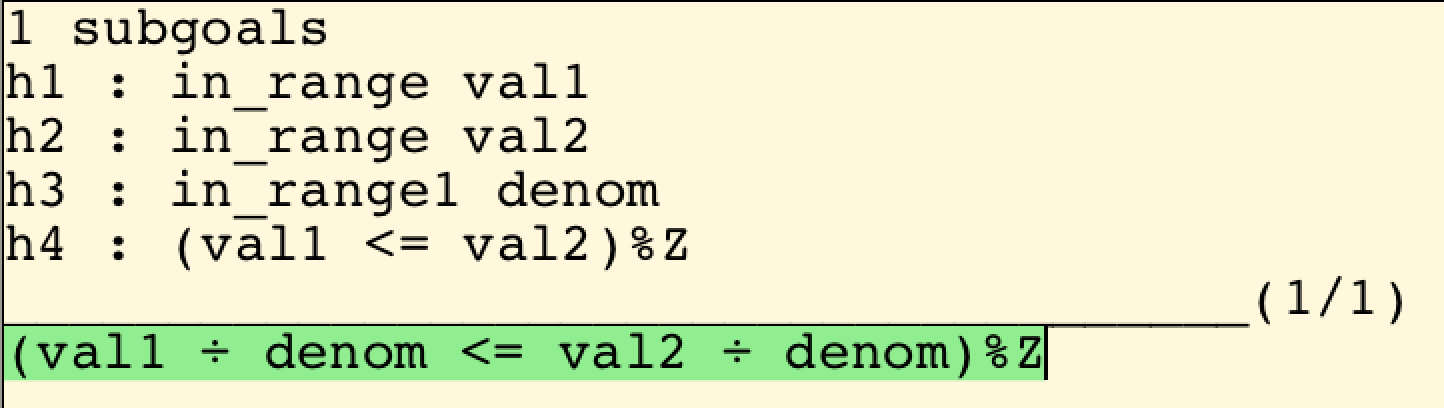
Currently, the SPARK lemma library provides the following lemmas:
Lemmas on signed integer arithmetic in file
spark-lemmas-arithmetic.ads, that are instantiated for 32 bits signed integers (Integer) in filespark-lemmas-integer_arithmetic.adsand for 64 bits signed integers (Long_Integer) in filespark-lemmas-long_integer_arithmetic.ads.Lemmas on modular integer arithmetic in file
spark-lemmas-mod_arithmetic.ads, that are instantiated for 32 bits modular integers (Interfaces.Unsigned_32) in filespark-lemmas-mod32_arithmetic.adsand for 64 bits modular integers (Interfaces.Unsigned_64) in filespark-lemmas-mod64_arithmetic.ads.GNAT-specific lemmas on fixed-point arithmetic in file
spark-lemmas-fixed_point_arithmetic.ads, that need to be instantiated by the user for their specific fixed-point type.Lemmas on floating point arithmetic in file
spark-lemmas-floating_point_arithmetic.ads, that are instantiated for single-precision floats (Float) in filespark-lemmas-float_arithmetic.adsand for double-precision floats (Long_Float) in filespark-lemmas-long_float_arithmetic.ads.Lemmas on unconstrained arrays in file
spark-lemmas-unconstrained_array.ads, that need to be instantiated by the user for their specific type of index and element, and specific ordering function between elements.
To apply lemmas to signed or modular integers of different types than the ones used in the instances provided in the library, just convert the expressions passed in arguments, as follows:
R1 := X1 / Y;
R2 := X2 / Y;
Lemma_Div_Is_Monotonic (Integer(X1), Integer(X2), Integer(Y));
--  at this program point, the prover knows that R1 <= R2
--  the following assertion is proved automatically:
pragma Assert (R1 <= R2);
5.11.8. Higher Order Function Library
The SPARK product also includes a library of higher order functions for unconstrained arrays. It is available using the SPARK library (see SPARK Library). Higher order functions over functional containers are provided in child packages of the functional containers instead (see Functional Containers Library).
This library consists of a set of generic entities defining usual operations on
arrays. As an example, here is a generic function for the map higher-level
function on arrays. It applies a given function F to each element of an
array, returning an array of results in the same order.
generic
   type Index_Type is range <>;
   type Element_In is private;
   type Array_In is array (Index_Type range <>) of Element_In;

   type Element_Out is private;
   type Array_Out is array (Index_Type range <>) of Element_Out;

   with function Init_Prop (A : Element_In) return Boolean with Ghost;
   --  Potential additional constraint on values of the array to allow Map

   with function F (X : Element_In) return Element_Out;
   --  Function that should be applied to elements of Array_In

function Map (A : Array_In) return Array_Out with
  Pre  => (for all I in A'Range => Init_Prop (A (I))),
  Post => Map'Result'First = A'First
    and then Map'Result'Last = A'Last
    and then (for all I in A'Range =>
                Map'Result (I) = F (A (I)));
This function can be instantiated by providing two unconstrained array types
ranging over the same index type and a function F mapping a component of the
first array type to a component of the second array type. Additionally, a
constraint Init_Prop can be supplied for the components of the first array
to be allowed to apply F. If no such constraint is needed, Init_Prop can
be instantiated with an always True function.
type Nat_Array is array (Positive range <>) of Natural;

function Small_Enough (X : Natural) return Boolean is
  (X < Integer'Last)
with Ghost;

function Increment_One (X : Natural) return Natural is (X + 1) with
  Pre => X < Integer'Last;

function Increment_All is new SPARK.Higher_Order.Map
  (Index_Type  => Positive,
   Element_In  => Natural,
   Array_In    => Nat_Array,
   Element_Out => Natural,
   Array_Out   => Nat_Array,
   Init_Prop   => Small_Enough,
   F           => Increment_One);
The Increment_All function above will take as an argument an array of
natural numbers small enough to be incremented and will return an array
containing the result of incrementing each number by one:
function Increment_All (A : Nat_Array) return Nat_Array with
  Pre  => (for all I in A'Range => Small_Enough (A (I))),
  Post => Increment_All'Result'First = A'First
  and then Increment_All'Result'Last = A'Last
  and then (for all I in A'Range =>
              Increment_All'Result (I) = Increment_One (A (I)));
Note
Unlike the SPARK Lemma Library, this library cannot be verified once and for all, as its correctness depends on the actual parameters of each instance. Each instance should be verified with GNATprove. This includes the ghost procedures documented as axioms, which state properties that the actual parameters should have (see Fold Functions for an example).
5.11.8.1. Map Functions
The Map function presented above is declared in file
spark-higher_order.ads, together with three variants:
Map_Itakes a functionFwith an additional parameter for the index of the element in the array.Init_Propalso takes this index as a parameter.Map_Procmodifies an array in place instead of returning a new array. The type of the elements is therefore the same before and after the application ofF.Map_I_Procmodifies an array in place and passes the index of the element toFandInit_Prop.
As an example, here is the declaration of Map_Proc:
generic
   type Index_Type is range <>;
   type Element is private;
   type Array_Type is array (Index_Type range <>) of Element;

   with function Init_Prop (A : Element) return Boolean with Ghost;
   --  Potential additional constraint on values of the array to allow Map

   with function F (X : Element) return Element;
   --  Function that should be applied to elements of Array_Type

procedure Map_Proc (A : in out Array_Type) with
  Pre  => (for all I in A'Range => Init_Prop (A (I))),
  Post => (for all I in A'Range => A (I) = F (A'Old (I)));
5.11.8.2. Fold Functions
Fold functions over unconstrained one-dimensional arrays are defined in file
spark-higher_order-fold.ads. They are declared as functions Fold inside
generic packages. The function Fold of package Fold_Left takes as
parameters an array A and an initial value Init and applies F
repeatedly to the elements of A from left to right, starting from Init.
On an array indexed from 1 to 3, it computes
F (A (3), F (A (2), F (A (1), Init))). Package Fold_Right provides the
same function going from right to left, and packages Fold_Left_I and
Fold_Right_I provide variants where F also takes the index of the
element as a parameter.
Here is the declaration of Fold_Left, without the postcondition of
Fold:
generic
   type Index_Type is range <>;
   type Element_In is private;
   type Array_Type is array (Index_Type range <>) of Element_In;
   type Element_Out is private;

   with function Ind_Prop
     (A : Array_Type; X : Element_Out; I : Index_Type) return Boolean
   with Ghost;
   --  Potential inductive property that should be maintained during fold

   with function Final_Prop (A : Array_Type; X : Element_Out) return Boolean
   with Ghost;
   --  Potential inductive property at the last iteration

   with function F (X : Element_In; I : Element_Out) return Element_Out;
   --  Function that should be applied to elements of Array_Type

package Fold_Left is

   function Fold (A : Array_Type; Init : Element_Out) return Element_Out
   with
     Pre => A'Length = 0 or else Ind_Prop (A, Init, A'First);

end Fold_Left;
The two ghost functions Ind_Prop and Final_Prop are used to describe
the intermediate values of the fold. Ind_Prop (A, X, I) should hold when
X is the value accumulated before processing the element at index I. It
can be used to show that the precondition of F is respected, for example to
rule out overflows. Final_Prop (A, X) should hold when X is the final
result. It can be used to state properties of the result of the fold. The
precondition of Fold requires Ind_Prop to hold for Init on the
first index of the array, if any. The instance of Fold_Left then contains
two ghost procedures Prove_Ind and Prove_Last which state respectively
that applying F preserves Ind_Prop and that applying F on the last
element establishes Final_Prop:
procedure Prove_Ind (A : Array_Type; X : Element_Out; I : Index_Type)
with
  Ghost,
  Pre  => I in A'Range and then Ind_Prop (A, X, I) and then I /= A'Last,
  Post => Ind_Prop (A, F (A (I), X), I + 1);
--  Axiom: Ind_Prop should be preserved when going to next index

procedure Prove_Last (A : Array_Type; X : Element_Out)
with
  Ghost,
  Pre  => A'Length > 0 and then Ind_Prop (A, X, A'Last),
  Post => Final_Prop (A, F (A (A'Last), X));
--  Axiom: Final_Prop should be provable at the last iteration from
--  Ind_Prop.
These procedures have null bodies, which are verified when the instance is
analyzed. If no such properties are needed, Ind_Prop and Final_Prop can
be instantiated with functions which always return True.
Packages Fold_Left, Fold_Right, Fold_Left_I, and Fold_Right_I
are defined using auxiliary packages with the _Acc suffix, which compute
the array of all intermediate values of the fold. They are only used to define
and verify the fold functions and should not be used directly.
As an example, here is how Fold_Left can be used to compute the maximal
element of an array of integers:
 1with SPARK.Higher_Order.Fold;
 2
 3package Array_Max is
 4
 5   type Int_Array is array (Positive range <>) of Integer;
 6
 7   function Max_Prefix
 8     (A : Int_Array; X : Integer; I : Positive) return Boolean
 9   is (for all K in A'First .. I - 1 => A (K) <= X)
10   with Ghost, Pre => I in A'Range;
11   --  X is greater than or equal to all the elements of A before I
12
13   function Max_All (A : Int_Array; X : Integer) return Boolean
14   is (for all K in A'Range => A (K) <= X)
15   with Ghost;
16   --  X is greater than or equal to all the elements of A
17
18   function Max (E : Integer; X : Integer) return Integer
19   is (Integer'Max (E, X));
20
21   package Fold_Max is new SPARK.Higher_Order.Fold.Fold_Left
22     (Index_Type  => Positive,
23      Element_In  => Integer,
24      Array_Type  => Int_Array,
25      Element_Out => Integer,
26      Ind_Prop    => Max_Prefix,
27      Final_Prop  => Max_All,
28      F           => Max);
29
30   function Max_Element (A : Int_Array) return Integer
31   is (Fold_Max.Fold (A, Integer'First))
32   with Post => Max_All (A, Max_Element'Result);
33
34end Array_Max;
Max_Prefix (A, X, I) states that X is greater than or equal to all
the elements of A before index I. It trivially holds for
Integer'First on the first index of A, as there are no elements before
it. GNATprove verifies that applying Max preserves Max_Prefix and
that it establishes Max_All on the last element of the array, which is
enough to prove the postcondition of Max_Element.
Fold functions are also provided for two-dimensional arrays in packages
Fold_2. They traverse the array row by row, from left to right and from
top to bottom. Ind_Prop then takes as parameters both the row and the
column of the next element. Two ghost procedures Prove_Ind_Col and
Prove_Ind_Row state that Ind_Prop is preserved when going to the next
column and to the next row respectively.
5.11.8.3. Sum and Count
For ease of use, the fold functions are instantiated in
spark-higher_order-fold.ads for the most common cases. Packages Sum and
Sum_2 compute the sum of all the elements of a one-dimensional or a
two-dimensional array, and Count and Count_2 the number of elements
with a given Choose property. These functions are defined recursively, so
reasoning about them generally requires induction. To avoid it, these packages
also provide ghost procedures, or lemmas, which state their most useful
properties.
The generic package Count takes as parameters an array type and a function
Choose on its elements. It provides a function Count returning the
number of elements of an array for which Choose returns True, as well as
the following lemmas:
Update_Countstates how the result ofCountchanges when a single element of the array is modified.Count_Zerostates thatCountreturns 0 if and only ifChoosereturnsFalseon all the elements of the array.Count_Lengthstates thatCountreturns the length of the array if and only ifChoosereturnsTrueon all the elements of the array.
As an example, here is a procedure that sets an element of an array of integers to zero, with a postcondition stating how the number of zeros in the array is affected:
 1with SPARK.Higher_Order.Fold;
 2
 3package Count_Zeros is
 4
 5   type Int_Array is array (Positive range <>) of Integer;
 6
 7   function Is_Zero (X : Integer) return Boolean is (X = 0);
 8
 9   package Zeros is new SPARK.Higher_Order.Fold.Count
10     (Index_Type => Positive,
11      Element    => Integer,
12      Array_Type => Int_Array,
13      Choose     => Is_Zero);
14   use Zeros;
15
16   procedure Reset (A : in out Int_Array; I : Positive)
17   with
18     Pre  => I in A'Range,
19     Post =>
20       Count (A) = (if A'Old (I) = 0 then Count (A'Old)
21                    else Count (A'Old) + 1);
22   --  Set A (I) to zero
23
24end Count_Zeros;
To verify this postcondition, a copy of the array before the modification is
saved in a ghost constant Old and the lemma Update_Count is called after
the modification:
 1package body Count_Zeros is
 2
 3   procedure Reset (A : in out Int_Array; I : Positive) is
 4      Old : constant Int_Array := A with Ghost;
 5   begin
 6      A (I) := 0;
 7      Update_Count (Old, A, I);
 8   end Reset;
 9
10end Count_Zeros;
The generic package Sum takes as parameters an array type, a type
Element_Out for the result, and a function Value computing the value of
each element of the array as an Element_Out. Element_Out is a private
type so that the package can be instantiated both with integer types and with
big integers. As a result, the addition Add on Element_Out and its
neutral element Zero are also provided at instantiation, along with two
ghost functions to express the absence of overflows: To_Big converts an
Element_Out into a big integer, and In_Range returns True on big
integers which can be represented in Element_Out.
The package provides a function Sum whose precondition No_Overflows
ensures that no intermediate result of the summation overflows. Its
postcondition relates its result to the sum on big integers
Big_Integer_Sum.Sum. The ghost package Big_Integer_Sum also provides the
following lemmas:
Update_Sumstates how the sum changes when a single element of the array is modified.Sum_Cstgives the value of the sum on an array whose elements all have the same value.
Here is an instance of Sum which computes the sum of the elements of an
array of integers:
 1with SPARK.Big_Integers; use SPARK.Big_Integers;
 2with SPARK.Higher_Order.Fold;
 3
 4package Sum_Ints is
 5
 6   type Int_Array is array (Positive range <>) of Integer;
 7
 8   function In_Integer_Range (X : Big_Integer) return Boolean
 9   is (In_Range (X, To_Big_Integer (Integer'First),
10                    To_Big_Integer (Integer'Last)))
11   with Ghost;
12
13   function Add (Left, Right : Integer) return Integer is (Left + Right)
14   with
15     Pre => In_Integer_Range (To_Big_Integer (Left) + To_Big_Integer (Right));
16
17   function Value (X : Integer) return Integer is (X);
18
19   package Sum_All is new SPARK.Higher_Order.Fold.Sum
20     (Index_Type  => Positive,
21      Element_In  => Integer,
22      Array_Type  => Int_Array,
23      Element_Out => Integer,
24      Add         => Add,
25      Zero        => 0,
26      To_Big      => To_Big_Integer,
27      In_Range    => In_Integer_Range,
28      Value       => Value);
29
30end Sum_Ints;
Packages Sum_2 and Count_2 provide the same functions and lemmas on
two-dimensional arrays.
5.11.8.4. Linked Structures in Arrays
The generic package SPARK.Higher_Order.Reachability in file
spark-higher_order-reachability.ads provides functions for reasoning about
acyclic linked structures stored in an array. They work on arrays that store
one or several linked structures using a Next function: for each cell in
the array, the index of the next cell is returned by Next. The end of a
structure is marked by a special value No_Index, which should not be a
valid index in the array. As an example, consider lists of integers stored in
an array, where the value 0 is used for No_Index:
   type Cell is record
      Value : Integer;
      Next  : Natural;
   end record;
   --  A cell of a list, the value 0 for Next marks the end of the list

   type Memory is array (Positive range <>) of Cell;

   function Next (C : Cell) return Natural is (C.Next);
In addition to the types of the indexes, of the cells, and of the array, the package takes as parameters instances of functional sets and sequences of indexes, which are used to describe the structures:
   package Index_Sets is new SPARK.Containers.Functional.Sets (Positive);

   package Index_Sequences is new
     SPARK.Containers.Functional.Infinite_Sequences
       (Positive, Use_Logical_Equality => True);
The Reachability package can then be instantiated for our lists:
   package Lists is new SPARK.Higher_Order.Reachability
     (Index_Type             => Positive,
      No_Index               => 0,
      Cell_Type              => Cell,
      Memory_Type            => Memory,
      Next                   => Next,
      Memory_Index_Sets      => Index_Sets,
      Memory_Index_Sequences => Index_Sequences);
The Reachability package defines three functions over these structures,
along with some lemmas that can be used to reason over them. Here are their
declarations, without their postconditions:
function Is_Acyclic (X : Extended_Index; M : Memory_Type) return Boolean
with
  Pre => X in M'Range | No_Index and then Valid_Memory (M);

function Reachable_Set
  (X : Extended_Index; M : Memory_Type) return Memory_Index_Set
with
  Pre => X in M'Range | No_Index and then Valid_Memory (M);

function Model (X : Extended_Index; M : Memory_Type) return Sequence
with
  Pre =>
    X in M'Range | No_Index
    and then Valid_Memory (M)
    and then Is_Acyclic (X, M);
They all take as parameters an index X, which may be No_Index, and an
array M, which should be well formed, as expressed by the function
Valid_Memory: M should start at Index_Type'First and the Next
value of each of its cells should be either a valid index in M or
No_Index. The function Is_Acyclic returns True if the linked
structure starting at X in M does not contain cycles. The function
Reachable_Set returns the functional set of all the indices in the array
that can be reached from X by calling Next repeatedly. Finally, the
function Model computes a functional sequence that stores the indices
reachable from X in the reverse of the order in which they occur: the first
element of the sequence is the last index of the structure, the one whose
Next is No_Index, and the last element is X itself.
The recursive definitions of these functions are given by lemmas which are
instantiated automatically by default, as in the instance Lists above. As
this might lead to instantiation loops, causing the context to grow too much for
complex proofs, it can be disabled by setting the generic parameter
Automatically_Instantiate_Definitions to False. The definitions can
then be made available for the verification of a subprogram by calling the
Disclose_* procedures of the package inside it.
The other lemmas of the package fall into two categories:
Lemmas stating general properties of reachability, for example that it is transitive (
Lemma_Reachable_Transitive) or that the model of a reachable cell is a prefix of the model of the head of the structure (Lemma_Model_Is_Prefix).Lemmas computing the new values of
Is_Acyclic,Reachable_Set, andModelafter a modification of the array. Lemmas with the_Preservedsuffix handle the case where a whole structure is left unchanged, lemmas with the_Preserved_Untilsuffix the case where a segment of a structure is left unchanged, and lemmas with the_After_Setsuffix the case where theNextvalue of a single cell is updated.
As an example, the function Contains_Value below searches for a value in the
list starting at index X in our array of cells. Its postcondition is
expressed using Reachable_Set:
 1with Memory_Lists; use Memory_Lists;
 2use Memory_Lists.Index_Sets;
 3use Memory_Lists.Lists;
 4
 5package Linked_Lists is
 6
 7   function Contains_Value (M : Memory; X : Natural; V : Integer) return Boolean
 8   with
 9     Pre  =>
10       Valid_Memory (M) and then X in M'Range | 0 and then Is_Acyclic (X, M),
11     Post =>
12       Contains_Value'Result =
13         (for some I of Reachable_Set (X, M) => M (I).Value = V);
14   --  Search for V in the list starting at X in M
15
16end Linked_Lists;
Thanks to the automatic instantiation of the recursive definition of
Reachable_Set, the loop invariants and the loop variant are verified
without calling any lemma. When the loop exits, C is No_Index, so its
reachable set is empty. The assertion after the loop states this fact, from
which the postcondition follows using the loop invariant:
 1package body Linked_Lists is
 2
 3   function Contains_Value (M : Memory; X : Natural; V : Integer) return Boolean
 4   is
 5      C : Natural := X;
 6   begin
 7      while C /= 0 loop
 8         pragma Loop_Invariant (C in M'Range and then Is_Acyclic (C, M));
 9         pragma Loop_Invariant (Reachable_Set (C, M) <= Reachable_Set (X, M));
10         pragma Loop_Invariant
11           (for all I of Reachable_Set (X, M) =>
12              (if M (I).Value = V then Contains (Reachable_Set (C, M), I)));
13         pragma Loop_Variant (Decreases => Length (Reachable_Set (C, M)));
14
15         if M (C).Value = V then
16            return True;
17         end if;
18         C := M (C).Next;
19      end loop;
20      pragma Assert (Is_Empty (Reachable_Set (C, M)));
21      return False;
22   end Contains_Value;
23
24end Linked_Lists;
5.11.9. Input-Output Libraries
The following text is about Ada.Text_IO and its child packages,
Ada.Text_IO.Integer_IO, Ada.Text_IO.Modular_IO,
Ada.Text_IO.Float_IO, Ada.Text_IO.Fixed_IO,
Ada.Text_IO.Decimal_IO and Ada.Text_IO.Enumeration_IO.
The effect of functions and procedures of input-output units is partially modelled. This means in particular:
that SPARK functions cannot directly call procedures that do input-output. The solution is either to transform them into procedures, or to hide the effect from GNATprove (if not relevant for analysis) by wrapping the standard input-output procedures in procedures with an explicit
Global => nulland body withSPARK_Mode => Off.with Ada.Text_IO; function Foo return Integer is procedure Put_Line (Item : String) with Global => null; procedure Put_Line (Item : String) with SPARK_Mode => Off is begin Ada.Text_IO.Put_Line (Item); end Put_Line; begin Put_Line ("Hello, world!"); return 0; end Foo;
SPARK procedures that call input-output subprograms need to reflect these effects in their Global/Depends contract if they have one.
with Ada.Text_IO;

procedure Foo with
  Global => (Input  => Var,
             In_Out => Ada.Text_IO.File_System)
is
begin
   Ada.Text_IO.Put_Line (Var);
end Foo;

procedure Bar is
begin
   Ada.Text_IO.Put_Line (Var);
end Bar;
In the examples above, procedures Foo and Bar have the same
body, but their declarations are different. Global contracts have to
be complete or not present at all. In the case of Foo, it has an
Input contract on Var and an In_Out contract on
File_System, an abstract state from Ada.Text_IO. Without the
latter contract, a high message would be raised when running
GNATprove. Global contracts will be automatically generated for
Bar by flow analysis if this is user code. Both declarations are
accepted by SPARK.
5.11.9.1. State Abstraction and Global Contracts
The abstract state File_System is used to model the memory on
the system and the file handles (Line_Length, Col, etc.). This
is explained by the fact that almost every procedure in Text_IO
that actually modifies attributes of the File_Type parameter has
in File_Type as a parameter and not in out. This would be
inconsistent with SPARK rules without the abstract state.
All functions and procedures are annotated with Global, and Pre, Post if
necessary. The Global contracts are most of the time In_Out for
File_System, even in Put or Get procedures that update the
current column and/or line. Functions have an Input global
contract. The only functions with Global => null are the functions
Get and Put in the generic packages that have a similar
behavior as sprintf and sscanf.
5.11.9.2. Functions and Procedures Removed in SPARK
Some functions and procedures are removed from SPARK usage because they are not consistent with SPARK rules:
Aliasing
The functions
Current_Input,Current_Output,Current_Error,Standard_Input,Standard_OutputandStandard_Errorare turned off inSPARK_Modebecause they create aliasing, by returning the corresponding file.Set_Input,Set_OutputandSet_Errorare turned off because they also create aliasing, by assigning aFile_Typevariable toCurrent_Inputor the other two.It is still possible to use
Set_Inputand the 3 others to make the code clearer. This is doable by callingSet_Inputin a different subprogram whose body hasSPARK_Mode => Off. However, it is necessary to check that the file is open and the mode is correct, because there are no checks made on procedures that do not take a file as a parameter (i.e. implicit, so it will write to/read from the current output/input).Get_LinefunctionThe function
Get_Lineis disabled in SPARK because it is a function with side effects. Even with theVolatile_Functionaspect, it is not possible to model its action on the files and global variables in SPARK. The function is very convenient because it returns an unconstrained string, but a workaround is possible by constructing the string with a buffer:
with Ada.Text_IO;
with Ada.Strings.Unbounded; use Ada.Strings.Unbounded;

procedure Echo is
   Unb_Str : Unbounded_String := Null_Unbounded_String;
   Buffer  : String (1 .. 1024);
   Last    : Natural := 1024;
begin

   while Last = 1024 loop
      Ada.Text_IO.Get_Line (Buffer, Last);
      exit when Last > Natural'Last - Length (Unb_Str);
      Unb_Str := Unb_Str & Buffer (1 .. Last);
   end loop;

   declare
      Str : String := To_String (Unb_Str);
   begin
      Ada.Text_IO.Put_Line (Str);
   end;
end Echo;
5.11.9.3. Errors Handling
Status_Error (due to a file already open/not open) and Mode_Error are fully
handled.
Except for Layout_Error, which is a special case of a partially
handled error and explained in a few lines below, all other errors are
not handled:
Use_Erroris related to the external environment.Name_Errorwould require checking availability on disk beforehand.End_Erroris raised when a file terminator is read while running the procedure.
For an Out_File, it is possible to set a Line_Length and
Page_Length. When writing in this file, the procedures will add
Line markers and Page markers each Line_Length characters or
Page_Length lines respectively. Layout_Error occurs when
trying to set the current column or line to a value that is greater
than Line_Length or Page_Length respectively. This error is
handled when using Set_Col or Set_Line procedures.
However, this error is not handled when no Line_Length or
Page_Length has been specified, e.g., if the lines are unbounded,
it is possible to have a Col greater than Count'Last and
therefore have a Layout_Error raised when calling Col.
Not only the handling is partial, but it is also impossible to prove
preconditions when working with two files or more. Since
Line_Length etc. attributes are stored in the File_System, it
is not possible to prove that the Line_Length of File_2 has not
been modified when running any procedure that does input-output on File_1.
Finally, Layout_Error may be raised when calling Put to display the
value of a real number (floating-point or fixed-point) in a string output
parameter, which is not reflected currently in the precondition of Put as
no simple precondition can describe the required length in such a case.
5.11.10. Strings Libraries
The following text is about Ada.Strings.Maps, Ada.Strings.Fixed,
Ada.Strings.Bounded and Ada.Strings.Unbounded.
Global contracts were added to non-pure packages, and pre/postconditions were added to all SPARK subprograms to partially model their effects. In particular:
Effects of subprograms from
Ada.Strings.Maps, as specified in the Ada RM (A.4.2), are fully modeled through pre- and postconditions.Effects of most subprograms from
Ada.Strings.Fixedare fully modeled through pre- and postconditions. Preconditions protect from exceptions specified in the Ada RM (A.4.3). Some procedures are not annotated with sufficient preconditions and may raiseLength_Errorwhen called with inconsistent parameters. They are annotated with an exceptional contract.Under their respective preconditions, the implementation of subprograms from
Ada.Strings.Fixedis proven with GNATprove to be free from run-time errors and to comply with their postcondition, except for procedureMoveand those procedures based onMove:Delete,Head,Insert,Overwrite,Replace_Slice,TailandTrim(but the corresponding functions are proved).Effects of subprograms from
Ada.Strings.Boundedare fully modeled through pre- and postconditions. Preconditions protect from exceptions specified in the Ada RM (A.4.4).Under their respective preconditions, the implementation of subprograms from
Ada.Strings.Boundedis proven with GNATprove to be free from run-time errors, and except for subprogramsInsert,OverwriteandReplace_Slice, to comply with their postcondition.Effects of subprograms from
Ada.Strings.Unboundedare partially modeled. Postconditions state properties on the Length of the strings only and not on their content. Preconditions protect from exceptions specified in the Ada RM (A.4.5).The procedure
FreeinAda.Strings.Unboundedis not in SPARK as it could be wrongly called by the user on a pointer to the stack.
Inside these packages, Translation_Error (in Ada.Strings.Maps),
Index_Error and Pattern_Error are fully handled.
Length_Error is fully handled in Ada.Strings.Bounded and
Ada.Strings.Unbounded and in functions from Ada.Strings.Fixed.
However, in the procedure Move and the procedures based on it except for
Delete and Trim (Head, Insert, Overwrite, Replace_Slice
and Tail) from Ada.Strings.Fixed, Length_Error may be raised under
certain conditions. This is related to the call to Move. Each call of these
subprograms can be preceded with a pragma Assert to check that the actual
parameters are consistent, when parameter Drop is set to Error and the
Source is longer than Target.
--  From the Ada RM for Move: "The Move procedure copies characters from
--  Source to Target.
--
--  ...
--
--  If Source is longer than Target, then the effect is based on Drop.
--
--  ...
--
--  * If Drop=Error, then the effect depends on the value of the Justify
--    parameter and also on whether any characters in Source other than Pad
--    would fail to be copied:
--
--    * If Justify=Left, and if each of the rightmost
--      Source'Length-Target'Length characters in Source is Pad, then the
--      leftmost Target'Length characters of Source are copied to Target.
--
--    * If Justify=Right, and if each of the leftmost
--      Source'Length-Target'Length characters in Source is Pad, then the
--      rightmost Target'Length characters of Source are copied to Target.
--
--    * Otherwise, Length_Error is propagated.".
--
--  Here, Move will be called with Drop = Error, Justify = Left and
--  Pad = Space, so we add the following assertion before the call to Move.

pragma Assert
 (if Source'Length > Target'Length then
    (for all J in 1 .. Source'Length - Target'Length =>
       (Source (Source'Last - J + 1) = Space)));

Move (Source  => Source,
      Target  => Target,
      Drop    => Error,
      Justify => Left,
      Pad     => Space);
5.11.11. C Strings Interface
5.11.11.1. The Ada Standard Library
Interfaces.C.Strings is a library that provides an Ada interface to
allocate, reference, update and free C strings.
The provided preconditions protect users from getting
Dereference_Error and Update_Error. However, those
preconditions do not protect against Storage_Error and in general against
leaking memory allocated by New_String and New_Char_Array.
All subprograms are annotated with Global contracts. To model the
effects of the subprograms on the allocated memory, an abstract state
C_Memory is defined. Since chars_ptr is an access type that is
hidden from SPARK (it is a private type and the private part of
Interfaces.C.Strings has SPARK_Mode => Off), the user could
create aliases that SPARK would not be able to see. Hence, we consider
that calling Update on any chars_ptr modifies the allocated
memory, C_Memory, so that the effects of potential aliases are
modelled correctly.
Additionally, some subprograms are annotated with SPARK_Mode => Off:
To_Chars_Ptr: This function creates an alias, thus it is not compatible with SPARK.Free: There is no way for SPARK to know whether or not it is safe to deallocate these pointers. They might not be allocated on the heap or there might be some aliases, which could lead to dangling pointers.
Finally, the two functions used to allocate memory to create
chars_ptr objects are annotated with the Volatile_Function
aspect. Indeed, calling those functions twice in a row with the
same parameters would return different objects.
5.11.11.2. Precise C Strings Interface
The annotations on Interfaces.C.Strings do not allow for a precise handling
of the content of strings as it cannot reason about potential aliases between
strings. As an alternative, when precision is required, two wrappers over
Interfaces.C.Strings are provided in the SPARK library (see
SPARK Library).
In the package SPARK.C.Strings, C strings are handled as SPARK pointers.
Absence of aliasing and memory safety is ensured through ownership (see
Memory Ownership Policy). This handling allows for safe allocation and
reclamation of memory as well as precise contracts on the content of strings.
However, like for regular pointers, Storage_Error might occur due to
memory shortage.
Like for Interfaces.C.Strings, the To_Chars_Ptr function is disallowed
but Free is retained. It is left as an assumption for the user to make sure
that it is only called on a pointer allocated through New_String or
New_Char_Array and not on a value created in C code. Two additional
conversion functions are provided to convert to and from C strings coming from
Interfaces.C.Strings but they cannot be used safely in SPARK and are
annotated with SPARK_Mode => Off.
As opposed to Interfaces.C.Strings, the content of each string is modeled
separately instead of collapsed together in a single abstract state and all
subprograms are annotated with postconditions modeling the content of
the string. This allows for a precise handling of C strings in SPARK.
The package SPARK.C.Constant_Strings offers an alternative to
SPARK.C.Strings which does not enforce ownership at the cost of
immutability. Aliasing between C strings is allowed but the designated values
cannot be modified. The New_String and New_Char_Array are annotated with
SPARK_Mode => Off as they can cause memory leaks. Instead, a version of
To_Chars_Ptr taking as input an access to a constant char_array is
provided. The Update procedures are removed. It is left as an assumption
for the user to make sure that values of this type are never mutated by the
C code.
Here again, the content of each string is modeled separately and all functions are annotated with postconditions modeling the content of the string to allow for a precise handling of C strings in SPARK.
5.11.12. Addresses to Access Conversions
The run-time library System.Address_To_Access_Conversions enables
the user to convert System.Address values to general access-to-object
types. The conversions are subject to the same rules as
Unchecked_Conversion between such types (see Data Validity),
that is:
To_Pointeris allowed in SPARK and annotated withGlobal => null. On a call to this function, GNATprove will emit warnings to ensure that the designated data has no aliases and is initialized.To_Addressis forbidden in SPARK because it does not handle addresses.
5.11.13. Conversions Between Access Types
The package SPARK.Conversions.Access_Conversions provides generic functions
to convert between access types in SPARK. A conversion reinterprets the
designated object as an object of the target type, much like an
Unchecked_Conversion between the two object types, and is subject to the same
rules (see Data Validity): on an instantiation, GNATprove emits the
checks that ensure the reinterpretation is safe.
The unit provides four generic packages, each parameterized by a source and a target object type:
Access_Constant_ConversionsandAccess_Variable_Conversionshandle respectively access-to-constant and access-to-variable values, for target types whose values are always valid. The former providesConvert_Constant_Access; the latter also providesConvert_Access, whose result borrows its argument and can be used to modify the designated object.Access_Constant_Conversions_Potentially_InvalidandAccess_Variable_Conversions_Potentially_Invalidare the counterparts for a target type that may have invalid values (see Aspect Potentially_Invalid). A conversion then requires, at theSPARKlib_Defensiveassertion level (see Assertion Levels in the SPARK Library), that the reinterpreted value be valid.
In each case the result designates the same object as the argument, seen as the target type, and the two are known to be equal through the postcondition of the conversion function.
5.11.14. Cut Operations
The SPARK product also includes boolean cut operations that can be used to
manually help the proof of complicated assertions. These operations are
provided as functions in a library but are handled in a specific way by
GNATprove. They can be found in the SPARK.Cut_Operations package which
is available using the same project file as the SPARK Lemma Library.
This library provides two functions named By and So which are handled
in the following way:
If
AandBare two boolean expressions, provingBy (A, B)requires provingB, the premise, and thenAassumingB, the side-condition. WhenBy (A, B)is assumed on the other hand, GNATprove only assumesA. The propositionBis used for the proof ofA, but is not visible afterward.If
AandBare two boolean expressions, provingSo (A, B)requires provingA, the premise, and thenBassumingA, the side-condition. WhenSo (A, B)is assumed bothAandBare assumed to be true.
This allows introducing intermediate assertions to help the proof of some part of an assertion by still controlling in a precise way what is added to the enclosing context. This is interesting when doing complex proofs when the size of the proof context (the amount of information known at a given program point) is an issue.
In the example below, By is used to add the intermediate property B (I)
in the proof of C (I) from A (I):
with SPARK.Cut_Operations; use SPARK.Cut_Operations;

procedure Main with SPARK_Mode is
   function A (I : Integer) return Boolean with Import;
   function B (I : Integer) return Boolean with Import,
     Post => B'Result and then (if A (I) then C (I));
   function C (I : Integer) return Boolean with Import;
begin
   pragma Assume (for all I in 1 .. 100 => A (I));
   pragma Assert (for all I in 1 .. 100 => By (C (I), B (I)));
end;
To prove the assertion, GNATprove will attempt to verify both that B (I)
is true for all I and that C (I) can be deduced from B (I).
After the assertion, the call to B does not occur in the context anymore,
it is as if the assertion (for all I in 1 .. 100 => C (I)) had been written
directly. Remark that here, B is really a lemma. Its result does not matter
in itself (it always returns True) but its postcondition gives additional
information for the proof (see the SPARK Lemma Library for more
information about lemmas).
As can be seen in the example above, By and So may not necessarily
occur at top-level in an assertion. However, because of their specific
treatment, they are only allowed in specific contexts. We define these
supported contexts in a recursive way:
As the expression of a
pragma AssertorAssert_And_Cut;As an operand of an AND, OR, AND THEN, or OR ELSE operation which itself occurs in a supported context;
As the THEN or ELSE branch of an IF expression which itself occurs in a supported context;
As an alternative of a CASE expression which itself occurs in a supported context;
As the condition of a quantified expression which itself occurs in a supported context;
As a parameter to a call to either
ByorSowhich itself occurs in a supported context;As the body expression of a DECLARE expression which itself occurs in a supported context.